


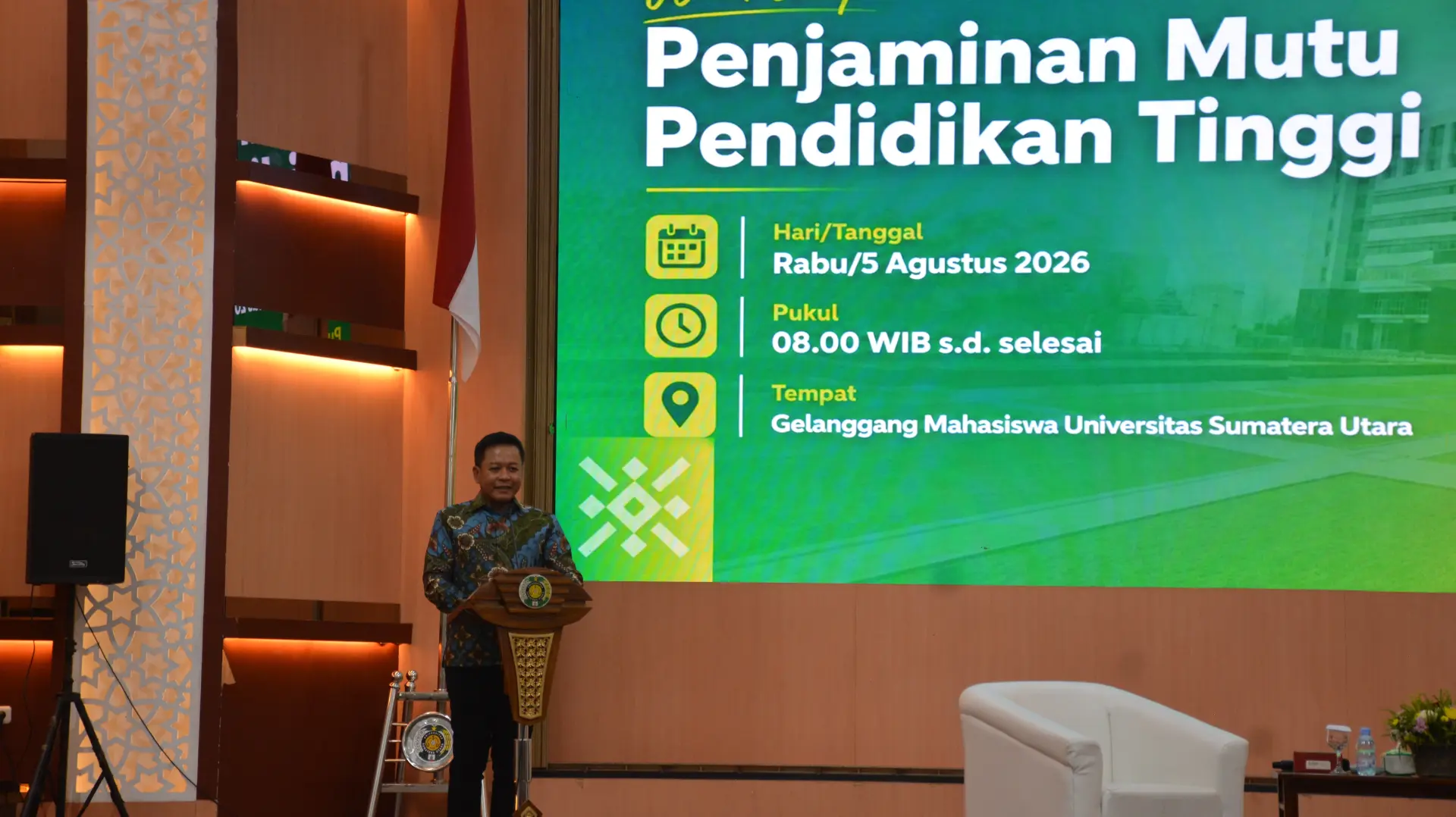
MEDAN – Universitas Sumatera Utara (USU), through its Directorate of Quality Assurance, continues to demonstrate its commitment to maintaining and improving higher education quality standards. This commitment was put into action through the Higher Education Quality Assurance Workshop, held at the USU Student Center on Wednesday (August 5, 2026).
The event, attended by university, faculty, and study program leaders, as well as internal quality assurance teams, focused on strengthening the internal quality culture and developing accreditation strategies. One of its main objectives was to maintain the “Unggul” (Excellent) accreditation status of Universitas Sumatera Utara.
USU Rector, Prof. Dr. Muryanto Amin, S.Sos., M.Si., emphasized that quality is the main foundation for the development of higher education institutions. Quality assurance should not be viewed merely as an administrative obligation, but rather as a work culture and institutional identity in providing the best possible services to students and the community.

The event featured Prof. Dr. Slamet Wahyudi, S.T., M.T., a key speaker from the Executive Board of the National Accreditation Board for Higher Education (BAN-PT). He presented the latest developments in the Higher Education Accreditation Instrument (IAPT), which now focuses on the effectiveness of the Internal Quality Assurance System (SPMI), the establishment of Key Performance Indicators (KPIs), as well as the differentiation and achievement of higher education institutions’ missions.
According to the provisions of the Higher Education Accreditation Instrument (IAPT), the “Unggul” (Excellent) status requires several key criteria, including:
- Consistent Implementation of SPMI: Having a cycle of Determination, Implementation, Evaluation, Control, and Improvement (PPEPP) that has been proven effective, sustainable, and integrated across all work units.
- Fulfillment of Mandatory Performance Indicators (Accreditation Prerequisites): These include the academic qualifications and functional positions of lecturers, an adequate number of permanent lecturers, lecturer-to-student ratios, and high-quality scholarly publications.
- Impact-Based Tridharma Achievements: Providing concrete evidence of curriculum effectiveness, graduate employability and success in the workforce, as well as research and community service contributions that generate broad impact.
- Mission Differentiation and Governance: Having a clear strategic direction supported by accountable, transparent, and internationally oriented governance.

The implementation of SPMI at USU has been carried out consistently, as demonstrated by the PPEPP cycle entering its 19th cycle in 2026. Through this workshop, the USU Quality Assurance Directorate, led by Prof. Setiawan, S.Kp., MNS., Ph.D., hopes that all work units across USU will share a common understanding and be ready to collaborate in fulfilling all IAPT standards in order to maintain the university’s “Unggul” (Excellent) accreditation status.